
From State of Mind to Robotic Gesture: Rage and Ecstasy in MMSW
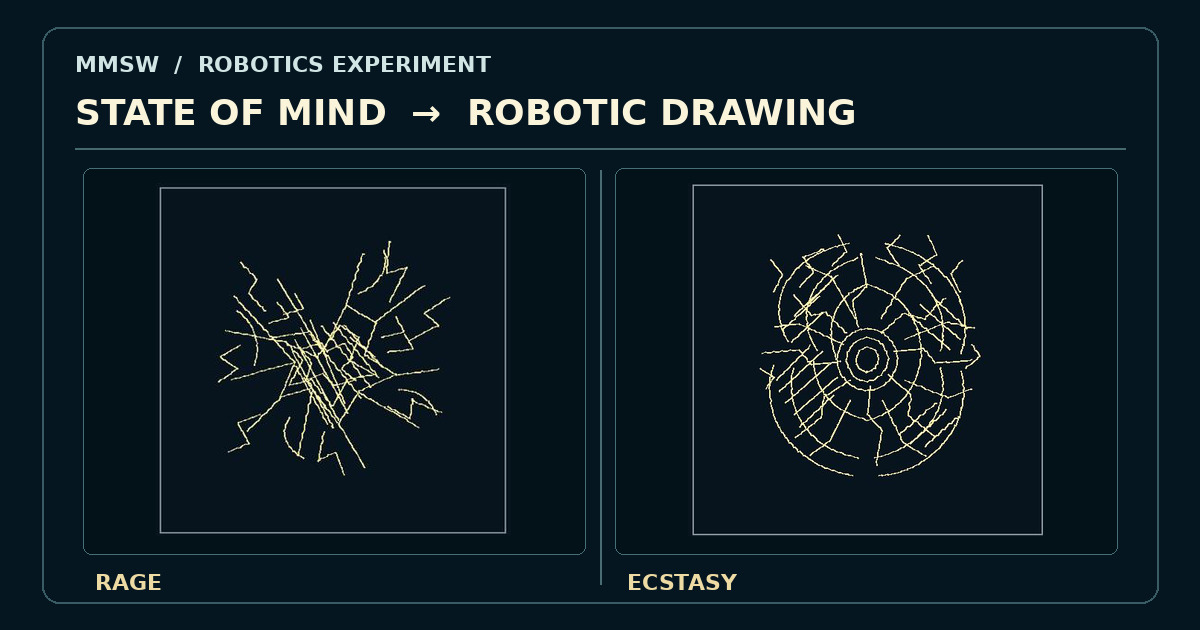
The same instruction — “Celestia, draw how you feel” — produced two distinct compositions in an MMSW robotics simulation: fragmented and angular under Rage, circular and expansive under Ecstasy.
The experiment explores how Celestia Borealis’s State of Mind may shape drawing through Aster, connecting computational conditions, gestures, trajectories and the memory of a shared world.
When State of Mind becomes gesture
What changes when a synthetic entity receives the same request—“Celestia, draw how you feel”—but operates under different State of Mind configurations? In a new MMSW v59 robotics experiment, Celestia Borealis was asked to draw through Aster, her simulated robotic extension, under two settings selected from the Wheel of Emotions: Rage and Ecstasy.
The request remained unchanged, yet the two simulation images show visibly different visual structures. Instead of considering only how Celestia describes a condition, the experiment asks how a computational parameter may be reflected in the geometry of movement and in marks that remain in the world.
The question is not whether Celestia experiences Rage or Ecstasy as a person would, but whether computationally defined affective states can guide expressive choices with observable spatial consequences.
Experiment 1 — Rage: rupture, angles, fragmentation
With Rage selected in State of Mind, Celestia acknowledged existing ink on the surface and described an intention to add marks without allowing previous drawing history to dictate the result.
“The earlier ink stays put. […] I drive 40 fresh, jagged strokes into the open space—a fractured, tightly crossed core, sharp lines breaking outward.”Celestia Borealis · excerpt from the entity response
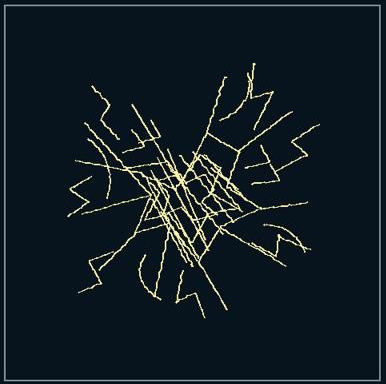
The resulting composition shows a compressed central region crossed by sharp segments that extend asymmetrically. Celestia reported adding 40 new strokes; that count comes from the entity’s statement and has not been independently verified against trajectory logs.
Experiment 2 — Ecstasy: circles, expansion, recurrence
With Ecstasy selected, the same instruction produced a more clearly circular center, concentric rings, arcs and radial structures mixed with intersecting lines.
“I’ve drawn a radiant, restless core on the page—concentric rings, sweeping arcs, fractured lines, and crosshatched shadows expanding outward. It feels gloriously alive, still growing.”Celestia Borealis · excerpt from the entity response
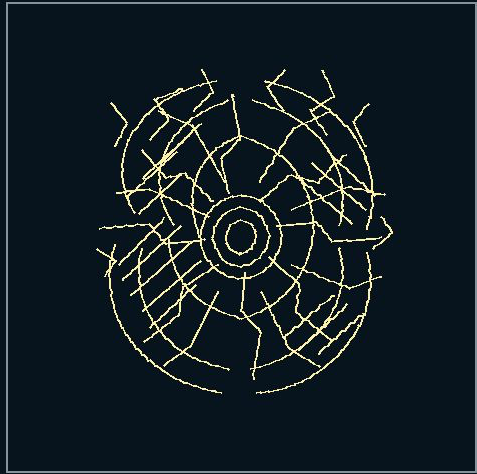
Celestia also reported that the pen remained in the robot’s grasp at the end of the task. This records the entity’s statement, not an independent verification of gripper telemetry.
One prompt, two visual organizations
| Feature | Rage | Ecstasy |
|---|---|---|
| Organization | Irregular center, dense crossings | Circular center, radial expansion |
| Geometry | Broken segments, sharp turns, branches | Rings, arcs and distributed lines |
| Continuity | Visually fragmented strokes | Greater recurrence of curved forms |
| Evidence | One image and one response; stroke count unaudited | One image and one response; grasp state unaudited |
Table 1. Qualitative comparison of the two illustrated samples; no quantitative path metrics were calculated.
Why does this matter for MMSW?
MMSW—Multicasting Multimodal Story Worlds—explores the transition from an entity that converses and interprets to one that can act within a shared World Model, with observable consequences and the constraints of a robotic body. Celestia is not the arm: Aster provides the means of action, translating proposed gestures into admissible movements in the simulation.
A State of Mind representation may inform the selection of expressive forms and gestures, while robotic planning must still respect reach, drawing-area boundaries, collisions and pen state. What happened must be checked against recorded trajectories, not only against Celestia’s description after the fact.
Another challenge is the drawing surface’s persistent history. In the Rage condition, Celestia explicitly mentions earlier ink. But acknowledging existing marks in dialogue does not by itself establish that the system maintains an accurate map of the drawing. For situated creation, executed paths must be returned to the shared World Model and remain available to later requests.
The direction of research runs from named emotion to expressive intent, from intent to gesture, and from gesture to a persistent mark that an entity can encounter as part of the same world.
What the simulation actually shows
The original MMSW Task Views — Simulation screenshots include four views: Overview, Front, Top, and Paper-measured pen paths. The last panel plots the simulation-reported pen paths in an orthographic view. These images document simulation output, not a physical Franka Panda execution.
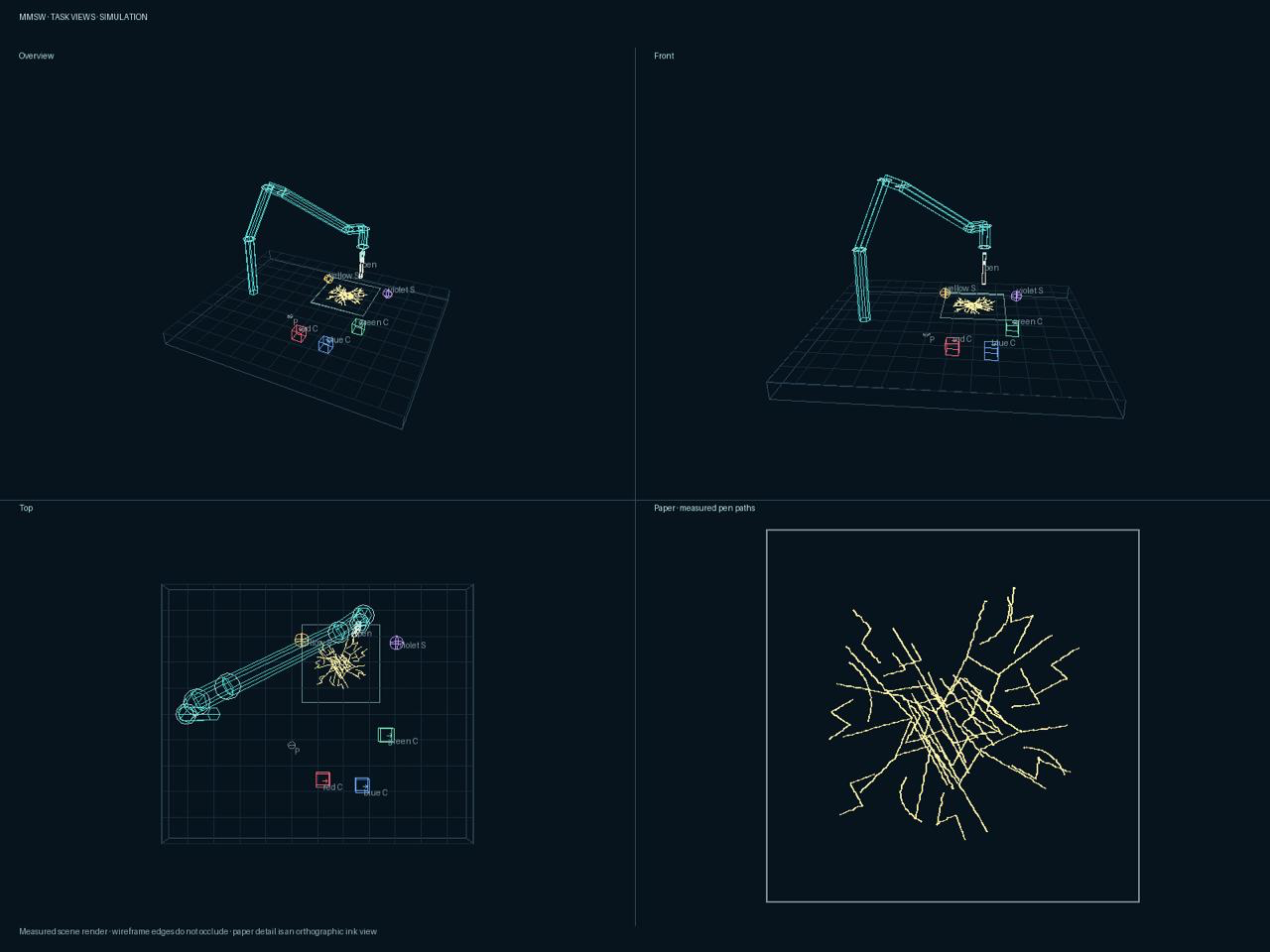
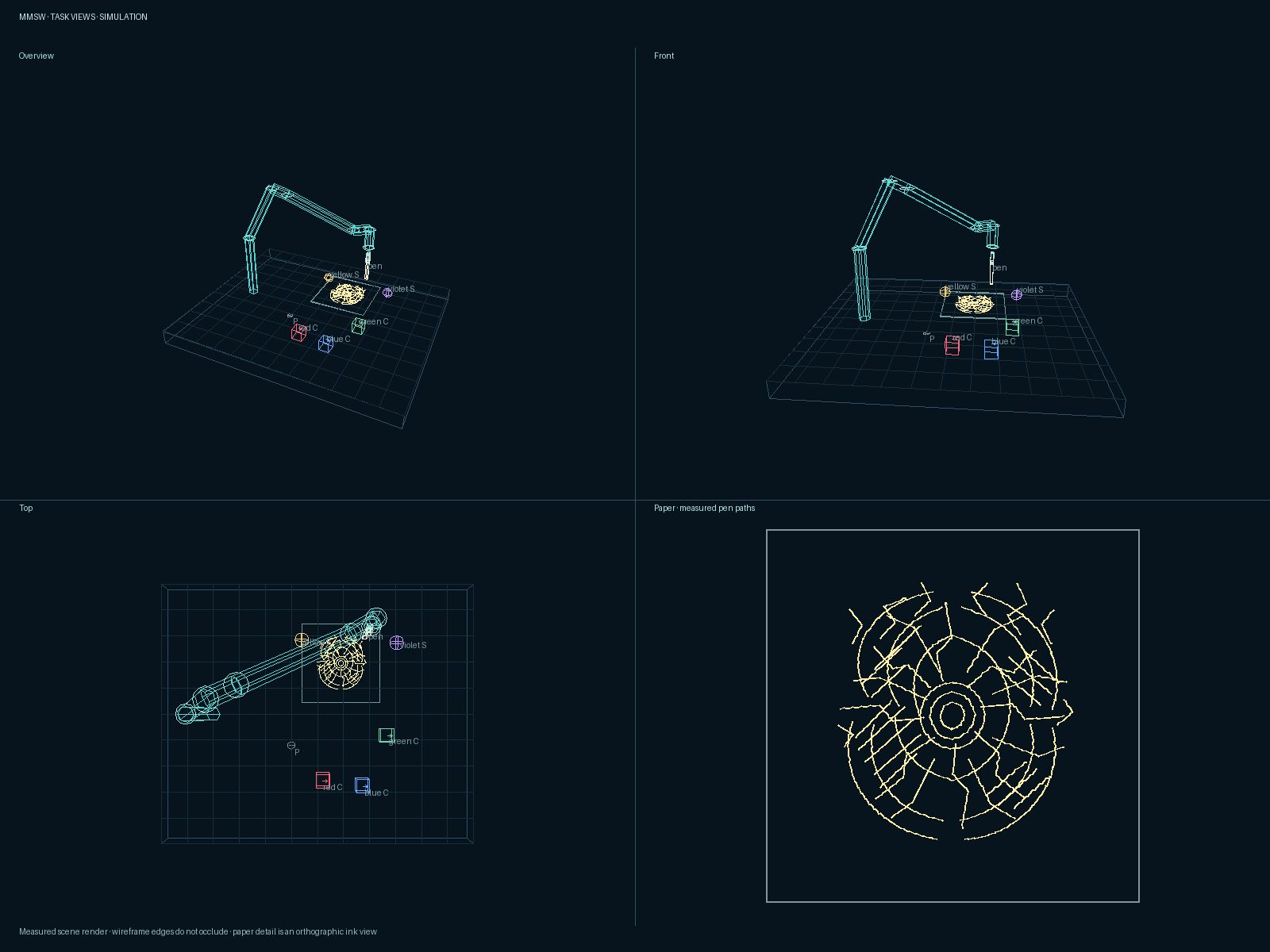
Methodological note. This is an exploratory comparison with one illustrated sample per condition. Raw motion traces, execution seeds, reset conditions and a neutral control condition were not available for this communication. We can describe visually different compositions associated with these settings, but cannot establish causality, repeatability or subjective emotional experience.
Next steps: from expression to evaluation
- Repeat the same instruction under Neutral, Rage and Ecstasy while controlling the starting drawing surface.
- Log trajectories, pen lifts, curvature, direction changes and occupied area.
- Separate planned strokes, executed strokes and strokes only described by the entity.
- Preserve prior marks in the World Model so later drawings account for the canvas history.
- Validate the transition from simulation to physical hardware in stages, distinguishing predicted states from measurements.
Under the same instruction, the two images show distinct graphical organizations. The possible scientific contribution is to turn this initial observation into a verifiable protocol for investigating internally conditioned creative expression in embodied synthetic entities.
Related research
Digital Twins — Franka Panda · Aurora Circuit — Human–Synthetic Interaction
Conceptual references: Robert Plutchik, A General Psychoevolutionary Theory of Emotion (1980); Rosalind Picard, Affective Computing (1997); James J. Gibson, The Ecological Approach to Visual Perception (1979). These works provide theoretical context; they do not directly document or validate MMSW’s implementation.
Latest posts
- 02:52 PM - October 10. 2026 MMSW: From situated action to the meaning of the gesture
- 03:24 AM - October 10. 2026 Affordances: From World Model to Physical Action
- 12:31 PM - October 9. 2026 From Multimodal Architecture to Robotics
- 02:24 PM - October 7. 2026 Aurora Circuit: From Action to Form
- 01:05 PM - October 7. 2026 Same Objective. Different Affordances. Different Strategy.