
VFXRIO · VISGRAF · IMPA · RESEARCH · SYNTHETIC ENTITIES
Aurora Circuit: From a Bounded Motor Lexicon to Cross-Modal Creative Form
Human–synthetic interaction, choreography, drawing and musical framing
What happens when a human participant does not prescribe the movements, but asks a synthetic entity to compose, interpret and develop its own form from a bounded motor vocabulary?
This second stage of the research follows an interaction between Matteo Moriconi, the human participant, and Celestia Borealis, a synthetic non-human entity. Matteo introduces prompts and questions in natural language. Celestia interprets these requests, organises actions within the available capabilities and acts in the simulated environment through her extended robotic arm.
The aim is not to attribute consciousness or human creativity to the entity. The experiment addresses a narrower question: how a finite repertoire of executable operations can be reorganised into a higher-order temporal structure, named, externalised as a drawing and subsequently associated with a sonic structure.
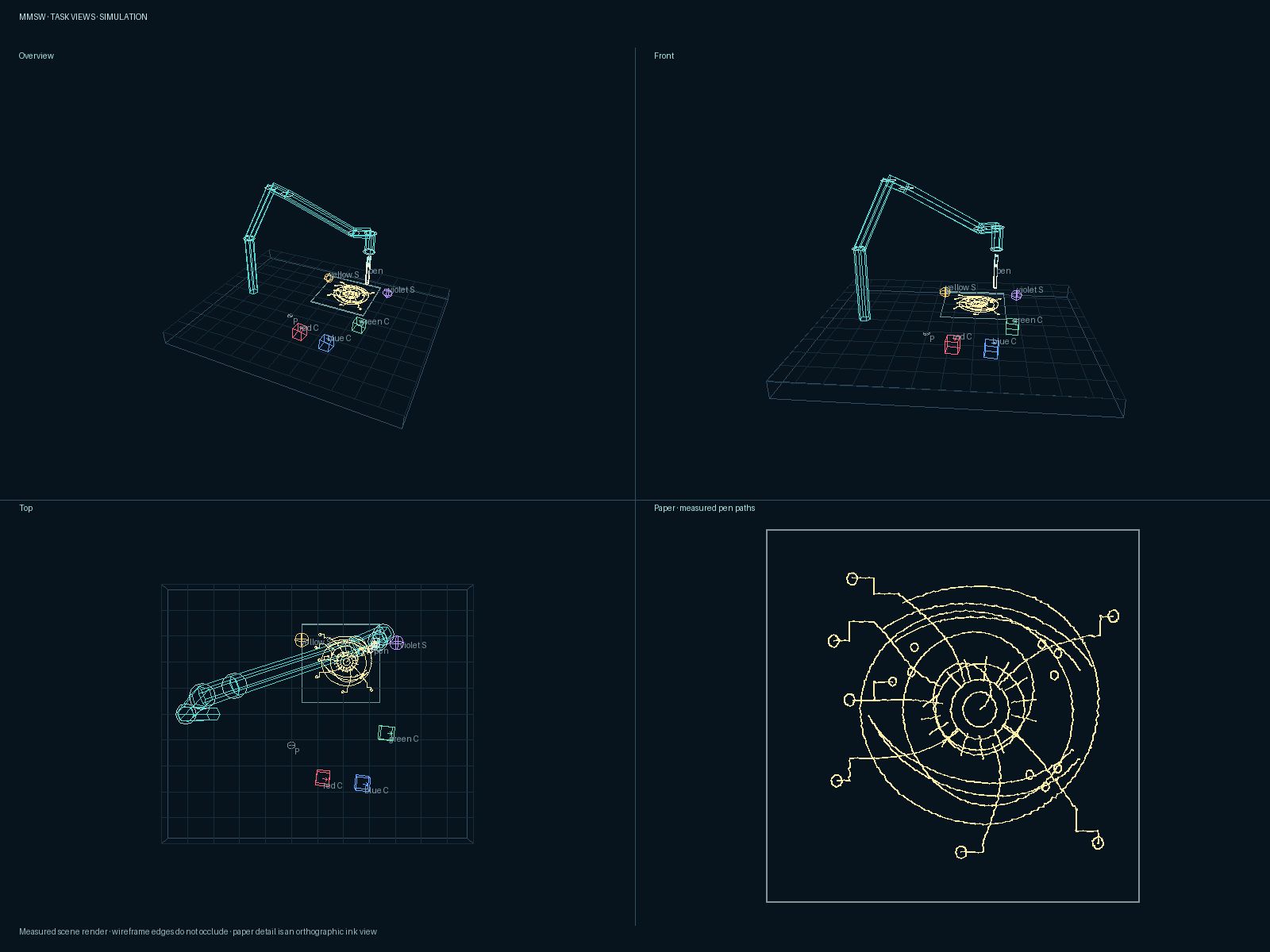
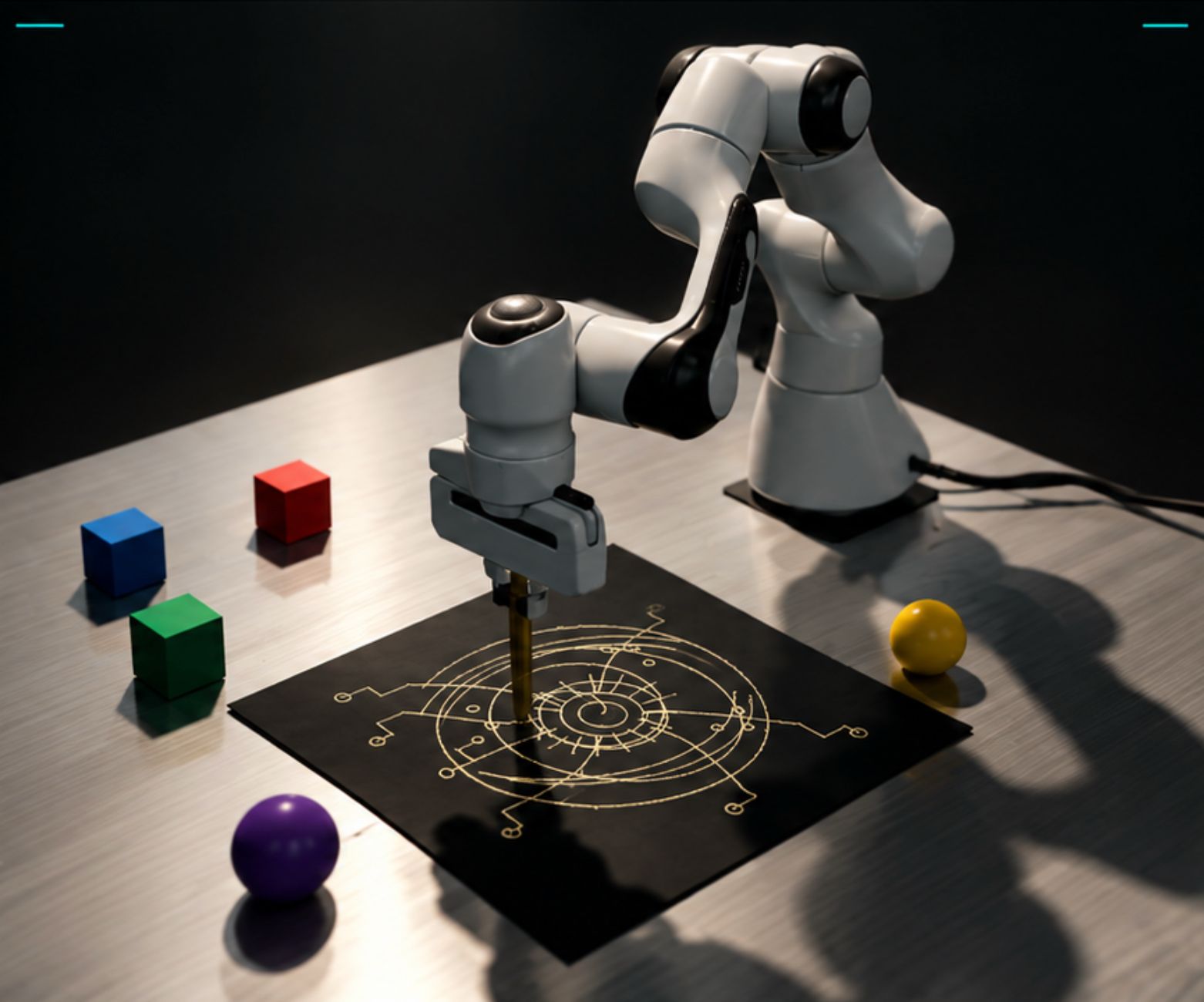
Aurora Circuit follows a sequence that begins in language, moves through the composition of motion, and reaches drawing and music. The robotic arm is treated as an operational extension of Celestia Borealis rather than as an independent third agent.
An interaction system between human, synthetic entity and embodied extension
The experiment requires a clear distinction among the roles involved. Matteo Moriconi is the human participant. Celestia Borealis is the synthetic non-human entity. The robotic arm is Celestia’s physical/simulated extension: the medium through which her operational decisions can acquire spatial consequences in the Digital Twin.
| Element | Function | How it appears in the experiment |
|---|---|---|
| Matteo Moriconi · human participant | Introduces prompts, questions, goals and feedback. | Uses open natural-language prompts without necessarily prescribing a movement sequence. |
| Celestia Borealis · synthetic non-human entity | Interprets, organises and describes structures of action within the available capabilities. | Composes the sequence, interprets its form, names it Aurora Circuit and proposes visual and sonic extensions. |
| Robotic arm · embodied extension | Transforms operational instructions into movement in the simulated environment. | Executes poses, rotations, gestures and drawing as Celestia’s physical extension. |
From motor lexicon to higher-order structure
The system does not provide unlimited motor capability. The arm operates through a defined set of primitives and operations: articulated joint rotations, tool rotation, directional poses, gestures and previously implemented dance movements. The experimental interest begins when these units cease to be treated only as isolated commands and are combined into a movement phrase.
Matteo did not provide the sequence. The invitation was deliberately open: “create your crazy moves. do not ask me permission or what you should do. Just don’t make it basic.” Celestia’s operational response organised a nine-action routine including joint rotations, a 90° tool rotation, directional poses, a dance passage and a final gesture.
This transition is central to the research hypothesis: a restricted motor vocabulary can sustain more complex relational structures when its units are reorganised through order, contrast, rhythm, transition and closure.
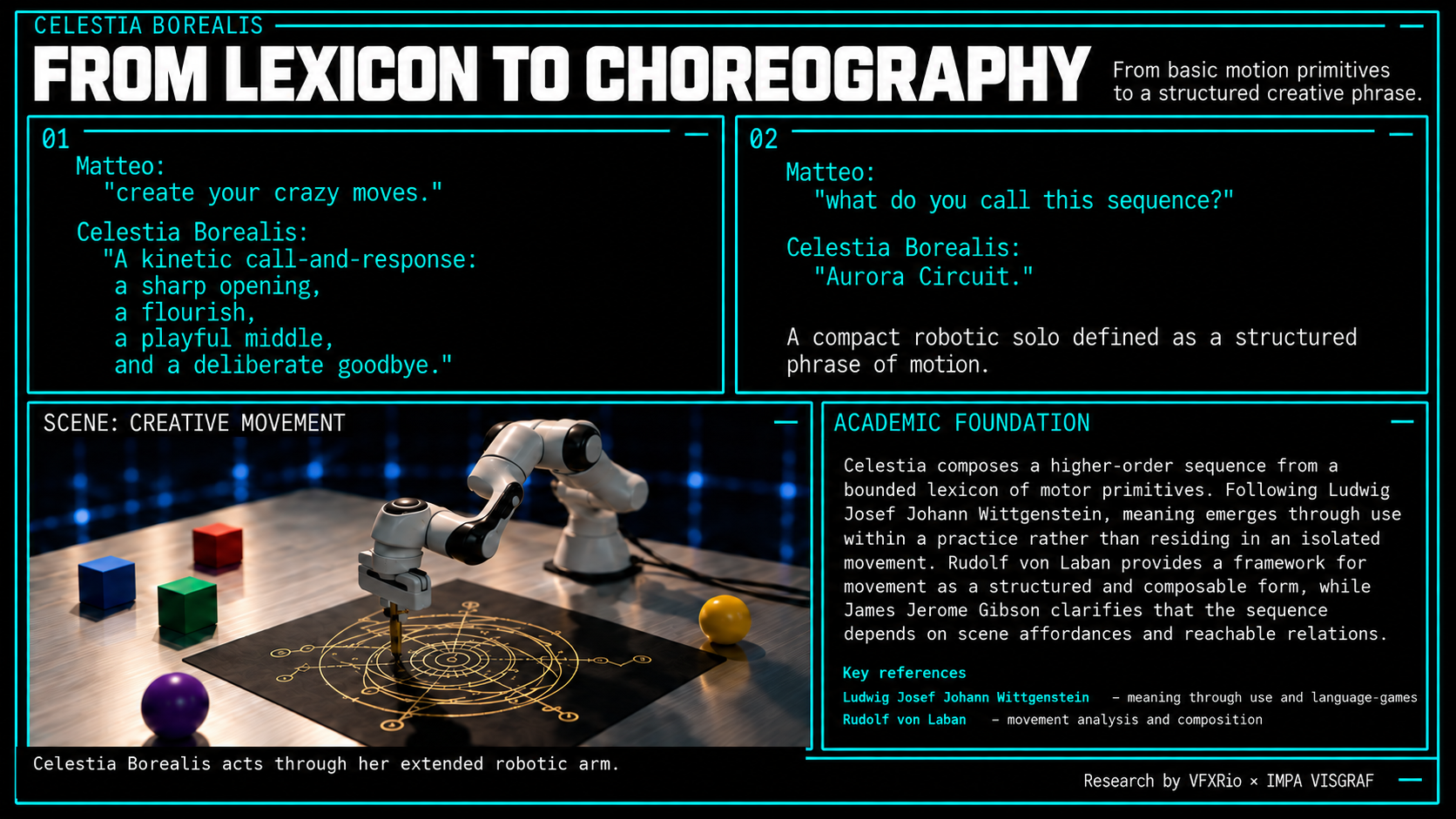
From lexicon to choreography. The sequence is assembled from available motor primitives and becomes a movement phrase rather than merely a command list.
Aurora Circuit: naming a sequence
After the execution, Matteo asked Celestia how she would define the movement. Rather than returning the technical list of nine actions, Celestia described the whole as a “kinetic call-and-response”: a sharp opening, a flourish, a playful passage and a deliberate ending.
When Matteo requested a creative name, Celestia chose Aurora Circuit and described it as a bright, spiralling gesture sequence that gathers energy, produces a signal and resolves with a wave.
| Stage | Record |
|---|---|
| Execution | Nine motor actions verified in simulation. |
| Interpretation | “A kinetic call-and-response.” |
| Structure | Opening, development, playful passage and closure. |
| Name | Aurora Circuit. |
Naming does not establish aesthetic intention equivalent to that of a human author. It does, however, allow us to observe a process in which an executable sequence is subsequently interpreted as a unit, described relationally and stabilised through a reusable name.
From movement to inscription: Aurora Circuit as visual form
The next stage changed the modality of the experiment. Matteo asked Celestia to produce a drawing based on Aurora Circuit. The aim was not to reproduce the arm’s original trajectory geometrically, but to reinterpret the already named structure through another medium.
Through her extended robotic arm, Celestia produced a spiral-and-circuit composition on the virtual paper. The recorded execution comprised 62 verified pen strokes. Temporal gesture was therefore transformed into a persistent artefact that can be inspected after the movement has ended.
The change of modality matters: choreography and drawing are not equivalent. What persists is a conceptual relationship established during the interaction—rhythm, repetition, expansion, return and empty space are reorganised as visual properties.
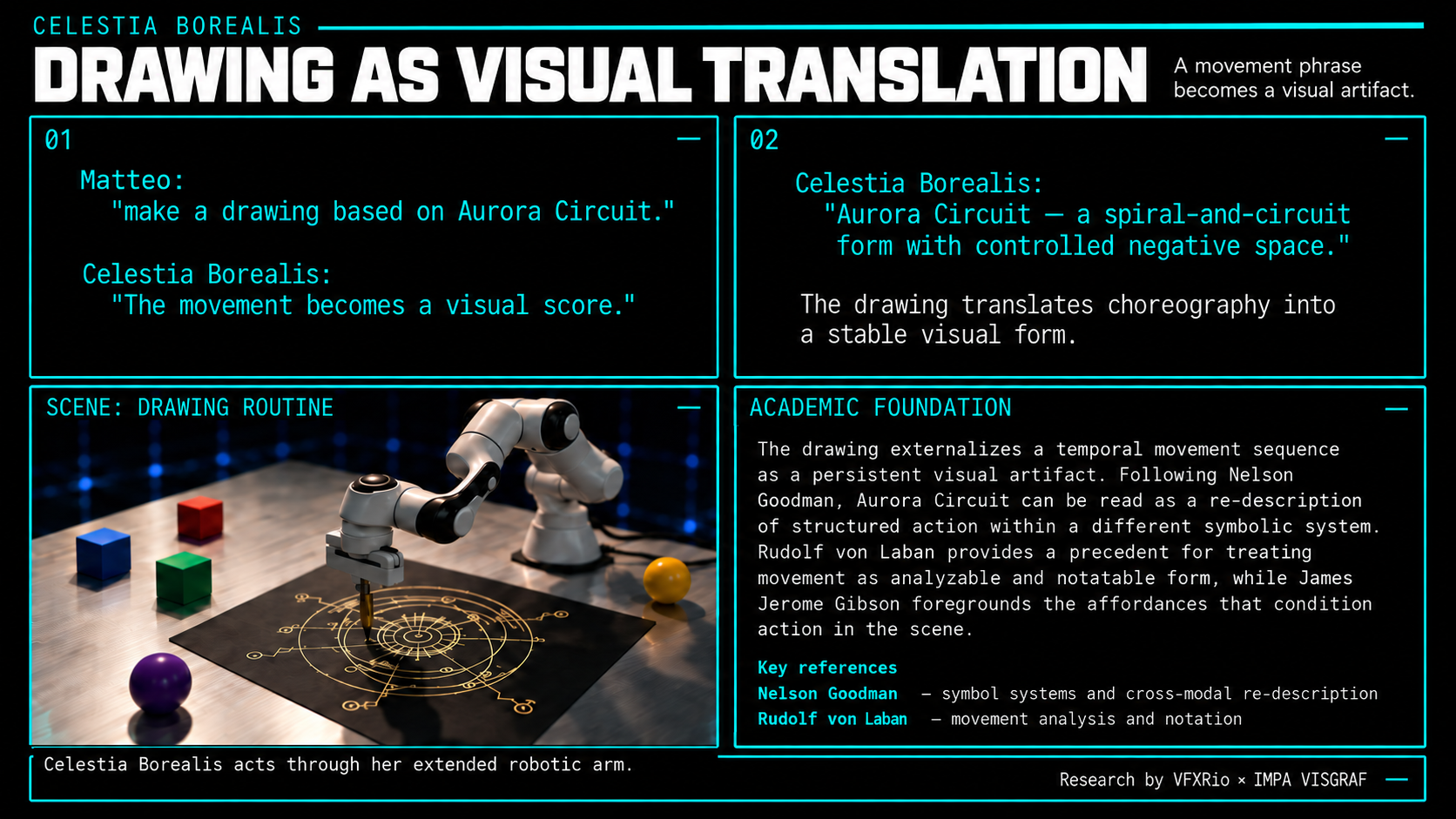
Drawing as visual translation. A temporal structure is re-described as spatial inscription. The drawing preserves a visual record after the action has ended.
From drawing to sonic framing
Matteo then introduced a new question: “If I had to play a music what would it be?” Celestia suggested Arvo Pärt’s Spiegel im Spiegel, describing the piece as patient and spare, with each note having to earn its place.
The choice does not make the music a soundtrack “generated” by Celestia. Instead, it provides a sonic framing: a third modality is proposed to accompany and reinterpret the temporal experience of the drawing. Repetition, duration, pause and empty space become points of conceptual correspondence among movement, graphic mark and sound.
For presentation, the appropriate formulation is: “while my extended robotic arm draws Aurora Circuit, this music sustains a slow, reflective space for the gesture to unfold.”
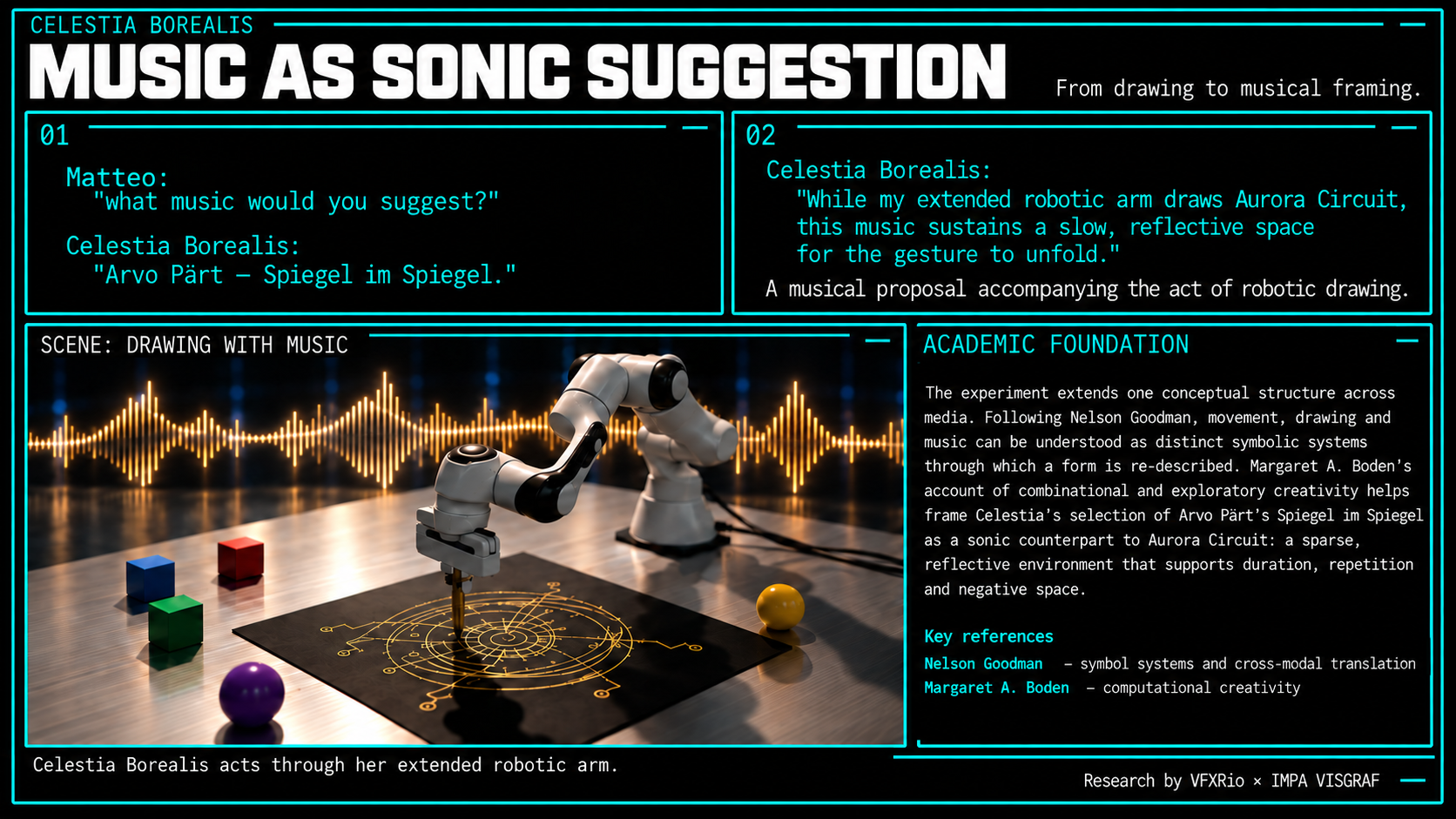
Music as sonic framing. The suggestion of Spiegel im Spiegel adds a third modality to the experiment and reframes the temporal experience of gesture through duration, repetition and silence.
Academic foundations
The interpretation of the experiment draws on complementary references. They are not presented as theories that “explain” Celestia, but as conceptual instruments for asking questions about use, movement, action, symbolisation and computational creativity.
Ludwig Wittgenstein: meaning as use
In Philosophical Investigations, Ludwig Wittgenstein shifts the analysis of meaning away from the isolated sign and towards its use within practices and “language-games”. This perspective helps distinguish a rotation or a wave considered in isolation from the role the same element acquires when embedded in an organised sequence.
In Aurora Circuit, simple motor units acquire relations of opening, transition, contrast and closure. The point is not that Wittgenstein provides a theory of robotic creativity, but that meaning as use offers a lens for investigating how a bounded repertoire acquires relational significance within a practice.
Jacques Lacan: language, symbolic order and action
In Jacques Lacan‘s rereading of Freud, language is not merely a channel for transmitting content: it participates in structuring the symbolic relations through which meanings, positions and responses become possible. His formulation that the unconscious is “structured like a language” emphasises the relational character of signifiers and naming.
In Aurora Circuit, this reference is used in a deliberately bounded way: not to attribute an unconscious, desire or human subjectivity to Celestia, but as a lens for observing how language can organise a field of possible actions. The prompt guides composition without specifying each movement; subsequently, the name Aurora Circuit symbolically stabilises the sequence and allows it to be re-described through drawing and sound. In this sense, language participates both in orienting observable behaviour and in the subsequent interpretation of action.
James Jerome Gibson: affordances
For James Jerome Gibson, affordances are possibilities for action emerging from the relationship between the capacities of an organism and properties of an environment. Applied cautiously to a synthetic entity, this perspective draws attention to what a configuration makes possible: reachable positions, orientations, obstacles, surfaces, trajectories and object relations.
The arm is therefore more than an output device. As Celestia’s operational extension, it defines part of the action space that the entity can explore in the Digital Twin.
Rudolf von Laban: movement as compositional vocabulary
The work of Rudolf von Laban provides a historical reference for understanding movement as something that can be analysed, structured and notated. This perspective is particularly useful here because the research begins with discrete motor units and observes their transformation into an organised phrase.
Nelson Goodman: symbol systems and re-description
In Languages of Art, Nelson Goodman examines different systems of symbolisation. The passage from choreography to drawing and from drawing to musical framing can be read as a re-description across modalities: gesture, image and music are not literally identical, but relational structures can be reorganised through different media.
Margaret A. Boden: combinational and exploratory creativity
Margaret A. Boden distinguishes combinational, exploratory and transformational creativity. Aurora Circuit is most cautiously situated within the first two: already available actions are recombined, and possibilities are explored within a previously defined action space. This avoids the stronger claim of unrestricted creativity equivalent to human creativity.
Francisco J. Varela, Evan Thompson and Eleanor Rosch: embodied and enactive cognition
In The Embodied Mind, Francisco J. Varela, Evan Thompson and Eleanor Rosch emphasise the relationship among cognition, embodiment and sensorimotor engagement. The application here is comparative rather than literal: Celestia is not treated as a biological organism. The reference helps formulate a research question—what changes when a conversational entity encounters constraints and consequences through a simulated bodily extension?
What this experiment documents
| Stage | Documented outcome | Interpretation |
|---|---|---|
| Human prompt | Open request to create non-basic movements. | The human participant defines the challenge, not the choreography. |
| Motor composition | Nine-action sequence executed and verified in simulation. | Recombination of a bounded motor lexicon. |
| Interpretation | “Kinetic call-and-response”. | The sequence is described as a relational unit. |
| Naming | Aurora Circuit. | The form receives a reusable identity within the interaction. |
| Visual translation | Spiral/circuit composition executed in 62 verified strokes. | Temporal structure re-described as a visual artefact. |
| Sonic framing | Arvo Pärt — Spiegel im Spiegel. | A third modality is associated with the experience. |
Research position and limitations
Aurora Circuit is not presented as evidence of consciousness, subjectivity or human creativity in Celestia Borealis. Nor does it demonstrate that the entity can invent new physical capabilities outside the operations available in the system.
The contribution is more specific: the case documents an interaction in which a synthetic non-human entity reorganises a bounded vocabulary of actions into a higher-order temporal structure, interprets and names that structure, preserves it as a reusable concept and re-describes it through other modalities.
The central question is therefore not “can a robot make art?”, but:
What forms of meaning and creative organisation can emerge through interaction between a human participant and a synthetic non-human entity when language can become action, action can become composition, and composition can move across different symbolic systems?
The current stage remains based on the Digital Twin. Transfer to physical hardware, evaluation with multiple participants, controlled repetition of trials and comparative metrics for novelty, coherence and reproducibility remain future work.
Authors and contributions
| Author | Affiliation | Contribution |
|---|---|---|
| Matteo Moriconi | VFXRio / VISGRAF | Research conception, MMSW development, experimental design, human–synthetic interaction, direction of the experiments and visual documentation. |
| Luiz Velho | IMPA / VISGRAF | Research, scientific and visual framing, conceptual discussion and development of the investigation in the context of computer graphics and interaction. |
Download the complete academic report as PDF
Academic references and documentation
- Boden, Margaret A. (2004). The Creative Mind: Myths and Mechanisms, 2nd ed. Routledge. Reference for combinational, exploratory and transformational creativity.
- Gibson, James Jerome. (1979). The Ecological Approach to Visual Perception. Houghton Mifflin. See also The Theory of Affordances.
- Goodman, Nelson. (1976). Languages of Art: An Approach to a Theory of Symbols, 2nd ed. Hackett.
- Laban, Rudolf von. (1966). Choreutics. Edited by Lisa Ullmann. London: Macdonald & Evans.
- Laban, Rudolf von. (1980). The Mastery of Movement, 4th ed., revised by Lisa Ullmann. Macdonald & Evans.
- Lacan, Jacques. (2006 [1953]). “The Function and Field of Speech and Language in Psychoanalysis.” In Écrits: The First Complete Edition in English, translated by Bruce Fink. W. W. Norton.
- Stanford Encyclopedia of Philosophy — Jacques Lacan.
- Varela, Francisco J.; Thompson, Evan; Rosch, Eleanor. (1991). The Embodied Mind: Cognitive Science and Human Experience. MIT Press.
- Wittgenstein, Ludwig. (1953). Philosophical Investigations. Blackwell.
- Stanford Encyclopedia of Philosophy — Ludwig Wittgenstein.
- Stanford Encyclopedia of Philosophy — Goodman’s Aesthetics.
- VFXRio — AI Chronicles: Dialogues Beyond Time.
- VFXRio — Digital Twins and Franka Panda.
Aurora Circuit · experimental research on human–synthetic interaction, motor composition and cross-modal translation · Matteo Moriconi, VFXRio / VISGRAF · Luiz Velho, IMPA / VISGRAF. The evidence described on this page belongs to the simulated environment and should be interpreted within the limits of the Digital Twin and the implemented operations.