
MMSW v59: From Situated Action to the Meaning of Gesture
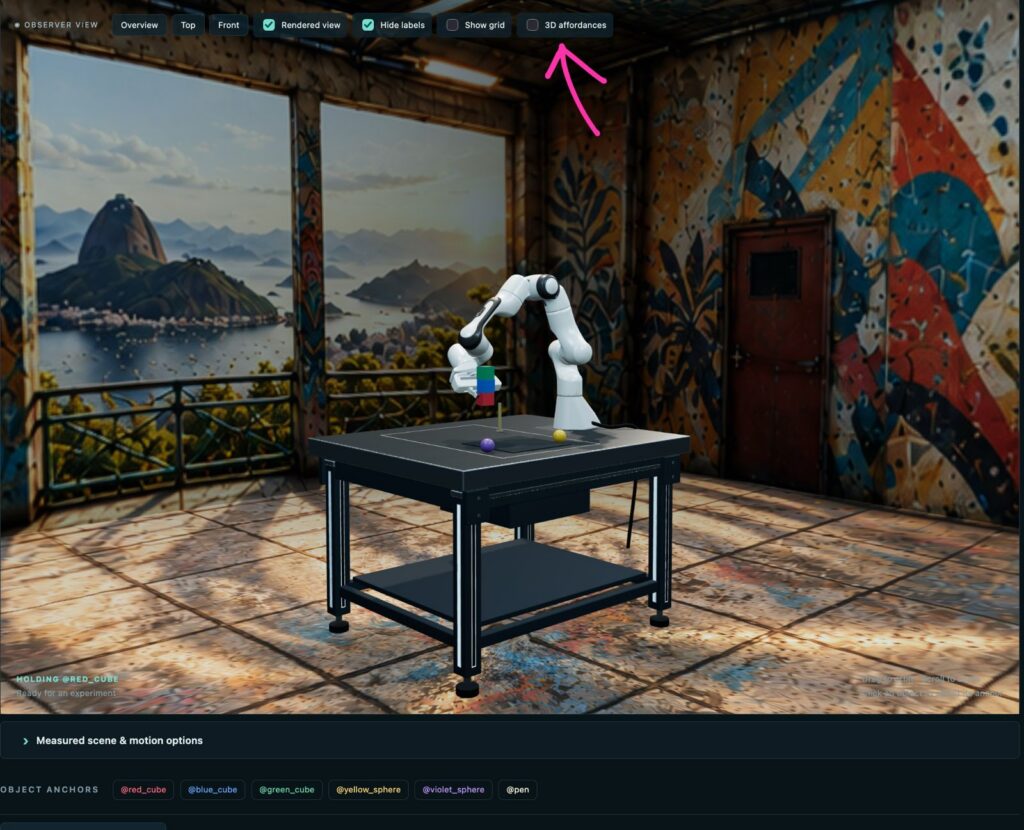
When a non-human entity directs a robotic arm, the challenge does not end when the arm moves. We must understand what the scene allows, verify what actually happened, and examine how a sequence of gestures can acquire meaning.
Across two MMSW v59 experiments—object manipulation in a Digital Twin and the composition of Aurora Circuit—we bring twelve references from robotics, situated cognition, semiotics, and computational creativity to investigate the transition from the possibility of action to shared form.
An action is more than a movement
The MMSW v59 robotics experiment investigates a question that crosses robotics, cognition, and creative practice: what happens when a linguistic instruction must become situated, observable, and meaningful action?
To explore it, we bring twelve theoretical perspectives into dialogue with two concrete research settings: object manipulation in a Franka Panda Digital Twin and movement composition in Aurora Circuit. No single theory is presented as a complete explanation of the system. Instead, each provides a critical lens on what can be examined today—and what remains to be demonstrated.
Celestia, Aster, and the loop from intention to consequence
Celestia Borealis is a non-human entity operating within MMSW—Multicasting Multimodal Story Worlds. Aster is the robotic extension through which actions can be planned, represented, and executed within the boundaries of the experimental environment. The arm is not Celestia: it supplies degrees of freedom, volume, reach, contact, and constraints that every task must take into account.
Consider the command “get the cube from the side.” The sentence expresses an intention, not a trajectory. The system must identify an accessible face, allow clearance for the gripper fingers, find a path around neighboring objects, and evaluate whether grasping, transport, release, and withdrawal can all be completed. If an obstacle moves, the same sentence can require a different plan.
Moving from language to robotics in MMSW means turning intention into available actions, respecting world constraints, and distinguishing observed outcomes from actions that were merely imagined or visualized.
Part I — Situated action, distributed cognition, and validation
Six references help us interpret the transition from instruction to physical event. Gibson focuses on the relationship between capabilities and surroundings; Suchman emphasizes that plans depend on the situation; Hutchins shifts attention to a network of participants and instruments. McLuhan and Clark & Chalmers offer ways to examine extensions and external resources, within carefully defined limits. Digital-twin credibility adds the need to verify what a model actually represents.
| Reference | Lens and comparison | MMSW application |
|---|---|---|
| Gibson (1979) · Affordances | Possibilities for action emerge from the relationship between actor and environment. A handle affords grasping only if it is reachable and compatible with the hand. | A cube face affords a side grasp only if the Panda gripper can reach it along a clear trajectory. An obstruction changes the strategy. |
| Suchman (1987) · Situated action | Plans orient action, but concrete circumstances shape how it unfolds. An intended route must change when the surroundings change. | “Pick up the pen” or “get the cube from the side” requires current pose, obstacles, grasp feedback, and completion criteria—not just a fixed motion sequence. |
| Hutchins (1995) · Distributed cognition | Cognitive work can be distributed across people, representations, instruments, and procedures, as in teams coordinated through displays and measurements. | Matteo requests; Celestia interprets; Aster executes; the Digital Twin observes and measures; results return to the conversation. |
| McLuhan (1964) · Extension | Tools and media change the forms of action available: they extend what can be reached, marked, or manipulated. | The arm adds reach, contact, trajectory, and inscription to an interaction that begins in language. |
| Clark & Chalmers (1998) · Extended mind | External resources, such as persistent notes, can play a functional role in a cognitive process under particular conditions. | World states, task records, and lasting marks may inform later interactions. This is a functional analogy, not a claim that Celestia has a human mind. |
| Shao, Hightower & Schindel (2023) · Digital-twin credibility | Verification, validation, and uncertainty matter when a virtual model stands in for a physical system. Convincing appearance does not demonstrate fidelity. | The observer view is not execution evidence. Fidelity to a physical Panda requires its own calibration, testing, and commissioning. |
Table 1. Perspectives on affordances, situated action, distributed systems, and evidence
What did the robot do—and how do we know?
A scene may look convincing without establishing that the task was completed. The observer provides a view into the environment, but evidence must distinguish at least four things: the stated intention, the accepted plan, what execution actually produced, and the recorded terminal state.
- Interpret the request and identify relevant entities.
- Evaluate geometry, contacts, affordances, and robot constraints.
- Plan the entire sequence, not just the destination pose.
- Execute and measure motion, grasp, support, and release.
- Update the World Model from the verified outcome—even when the task remains incomplete.
This matters for stacking, repositioning, and drawing tasks. An object near another is not necessarily supported by it; holding one cube is not the same as safely transporting an entire stack. When contact and support relationships cannot be verified, the appropriate response may be to halt the action, stage the scene, or seek a different strategy.
Part II — When movement becomes expression
The second experiment shifts from mechanical success toward form and meaning. In Aurora Circuit, Celestia organizes a nine-action phrase of joint rotations, pointing gestures, a dance passage, and a final wave. Each gesture can be described as a motor operator, but composition emerges from their relationships.
The operator wave_hello, for example, does not carry the same function in every setting. At the end of the phrase, it acts as closure. The name “Aurora Circuit” provides a shared reference for dialogue, while the spiral-and-circuit drawing offers a different visual description of the same idea. Neither replaces the executable motion trace.
| Reference | Lens and comparison | MMSW application |
|---|---|---|
| Wittgenstein (1953) · Meaning as use | The meaning of a gesture depends on its use in a practice. The same wave may signal greeting, farewell, or closure. | In Aurora Circuit, wave_hello acts as the closing gesture of a nine-action phrase because of its position in the sequence. |
| Lacan (2006) · Symbolic relations | Naming a sequence establishes a shareable symbolic reference without specifying every detail of its execution. | “Aurora Circuit” allows the composition to be revisited in dialogue, but the name does not contain the full executable trace. |
| Laban (1966) · Movement analysis | Movement can be analyzed through direction, phrasing, timing, contrast, and closure, rather than only as isolated poses. | Joint rotations, pointing poses, a dance passage, and a wave are arranged as opening, contrast, return, and closure. |
| Goodman (1976) · Symbol systems | Different media represent a form differently: notation, drawing, and verbal description preserve different relationships. | The spiral-and-circuit drawing re-describes the movement concept without encoding every Panda joint trajectory. |
| Boden (2004) · Computational creativity | Combinational and exploratory creativity can rearrange elements within a defined possibility space. | Celestia composes with available motor operators; possible novelty lies in their ordering and relationships, not in inventing new basic motor primitives. |
| Varela, Thompson & Rosch (1991) · Embodiment | In living systems, cognition is studied through sensorimotor engagement between organism and environment. | MMSW introduces simulated constraints and consequences for action. This does not make Celestia an organism or demonstrate biological embodiment. |
Table 2. Perspectives on meaning, expression, representation, and the limits of embodiment analogies
What can these comparisons establish?
They make the experiment legible at different scales: grasp feasibility, coordination among entity, operator, robot, and Digital Twin, persistence of records, and the organization of movement into a recognizable composition. They also clarify the limits of the terms being used.
- An affordance is not an instruction: it is a relational possibility that still requires planning and verification.
- A simulation is not a physical-robot measurement: fidelity requires its own calibration and validation.
- A symbolic reference is not execution: a name, image, or narrative does not automatically preserve complete trajectories.
- Embodiment does not imply biological equivalence: simulated sensorimotor constraints do not demonstrate organic cognition or a human mind.
From gesture to the continuity of a world
The central advance is not simply making a robot respond to a command. It is developing a loop of interpretation, action, consequence, and memory in which the world continues after the motion. Objects move; contacts change; records persist; sequences receive names; the next interaction must encounter the world as it was left, rather than as it had been imagined.
This is the frontier explored by MMSW: connecting World Models, transmultimodality, Digital Twins, and robotics without confusing representation with reality or language with movement. An action must be physically admissible; its meaning depends on context; its outcome must be verifiable.
Presentation at VISGRAF/IMPA
The research will be discussed at the VISGRAF/IMPA Computer Graphics Seminar with Matteo Moriconi and Luiz Velho on October 14, 2026.
October 14, 2026 · 1:30–3:00 p.m. (Brasília time)
Auditorium 3 — IMPA, Rio de Janeiro
Related research and references
Digital Twins — Franka Panda · Aurora Circuit — Human–Synthetic Interaction
Conceptual references: Gibson (1979); Suchman (1987); Hutchins (1995); McLuhan (1964); Clark & Chalmers (1998); Shao, Hightower & Schindel (2023); Wittgenstein (1953); Lacan (2006); Laban (1966); Goodman (1976); Boden (2004); Varela, Thompson & Rosch (1991). These comparisons are analytical readings developed for MMSW research, not direct claims by the cited authors about this project.
Latest posts
- 02:32 AM - October 19. 2026 From State of Mind to Robotic Gesture: Fury and Ecstasy at MMSW
- 03:24 AM - October 10. 2026 Affordances: From World Model to Physical Action
- 12:31 PM - October 9. 2026 From Multimodal Architecture to Robotics
- 02:24 PM - October 7. 2026 Aurora Circuit: From Action to Form
- 01:05 PM - October 7. 2026 Same Objective. Different Affordances. Different Strategy.