
WIREFACE
Technical Report: Multi-View Embodiment for Artificial Entities
An experimental architecture for identity, voice, movement, spatial presence and observability
Developed in collaboration by Prof. Luiz Velho (VISGRAF Laboratory, IMPA) and Matteo Moriconi (VFXRio).
Technical Abstract
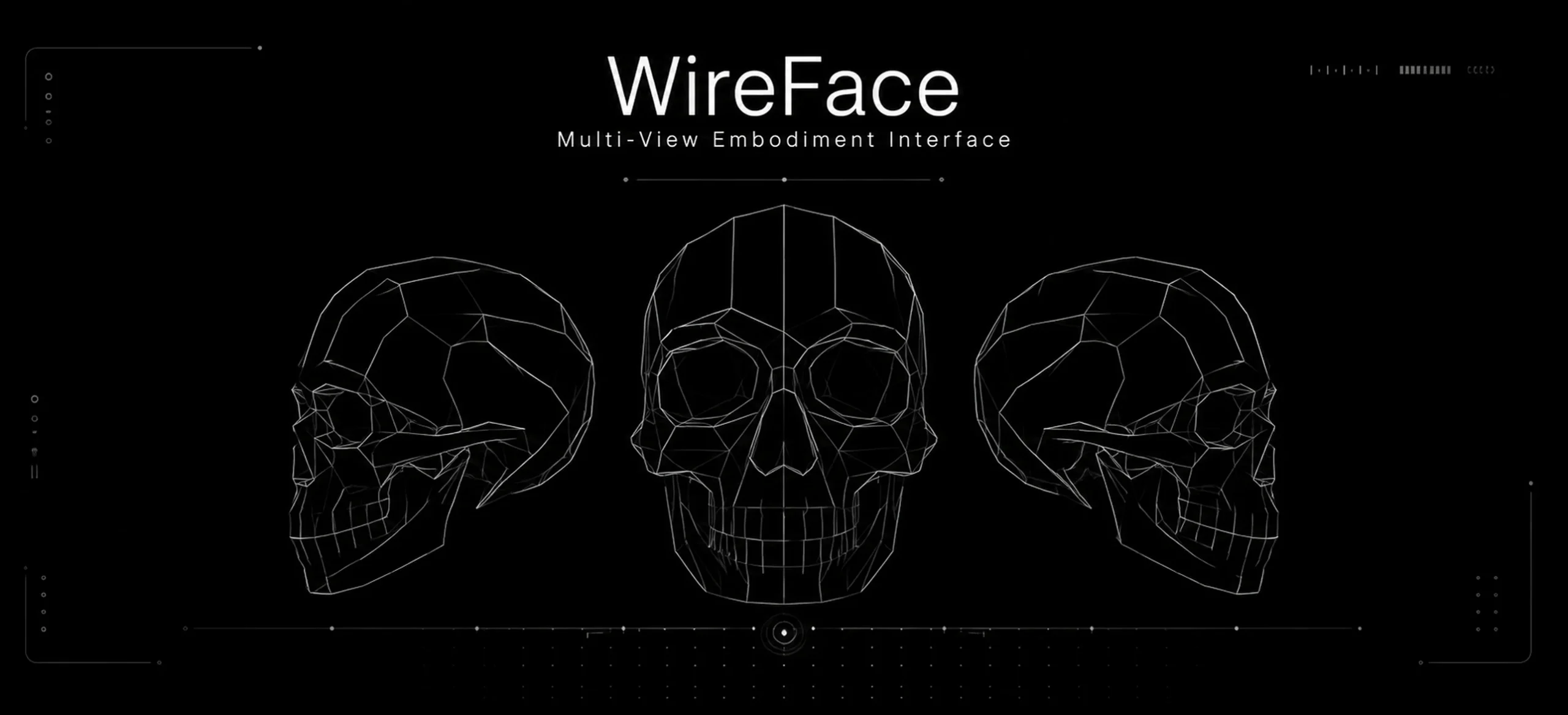
WireFace is a research prototype for studying how an artificial entity can preserve identity and temporal coherence while manifesting through voice, movement and spatial presence.
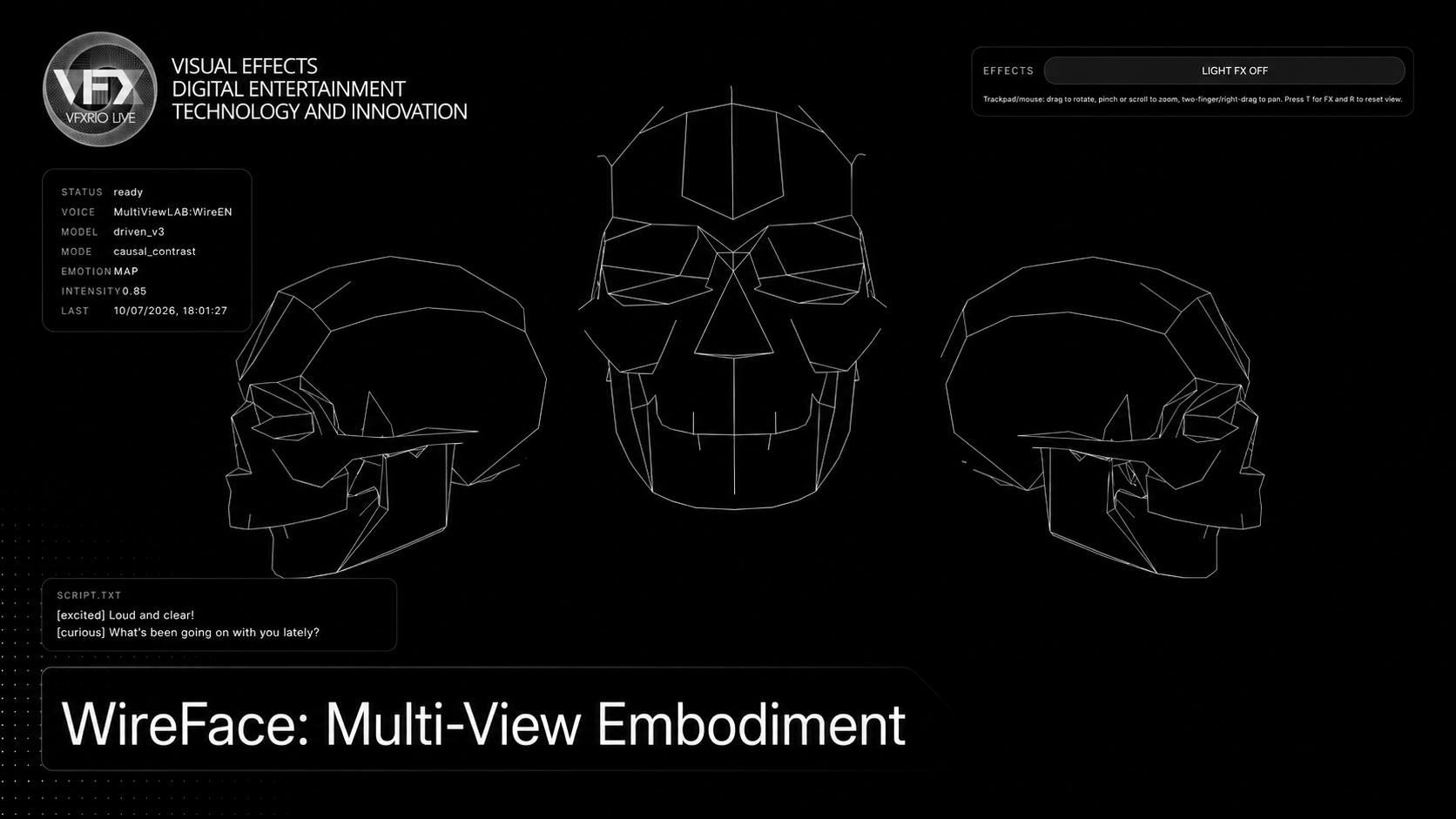
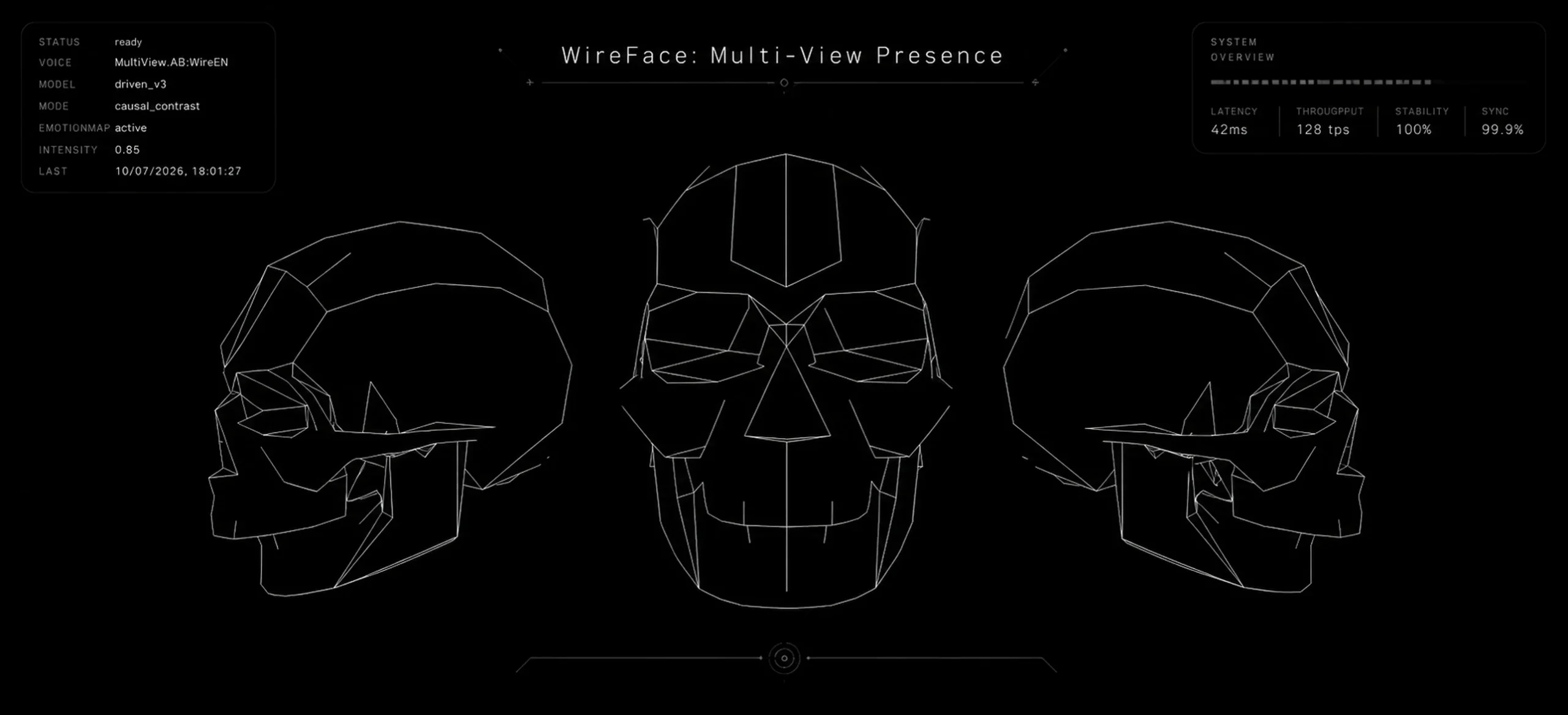
The interface presents three abstract wireframe heads as simultaneous views of the same entity. The views share response, voice, state and performance data; they do not represent three independent entities. This configuration makes connectivity, latency, synchronization, expression and continuity between messages observable.
Experimental scope. The system instruments the path from receipt of a response to its audiovisual manifestation. The architecture was designed to compare components and study digital, holographic, volumetric, robotic, projected or installation-based forms. The applications described in this report are technical possibilities and do not, by themselves, constitute field validation.
Research collaboration: Prof. Luiz Velho — VISGRAF Laboratory, IMPA
Matteo Moriconi — VFXRio
Research Question and Operational Hypothesis
The central question is whether a single entity can preserve identity, context and perceptual continuity when its response crosses different channels and viewpoints.
The operational hypothesis is that embodiment forms part of the communicative output. Voice, orientation, movement, rhythm and visual state influence how a response is read and must therefore be handled as synchronized, traceable and measurable components.
WireFace makes this transition observable by recording when each stage begins and ends, how state persists between messages, and where delays, failures or synchronization drift alter the manifestation.
Architecture and MMSW Integration
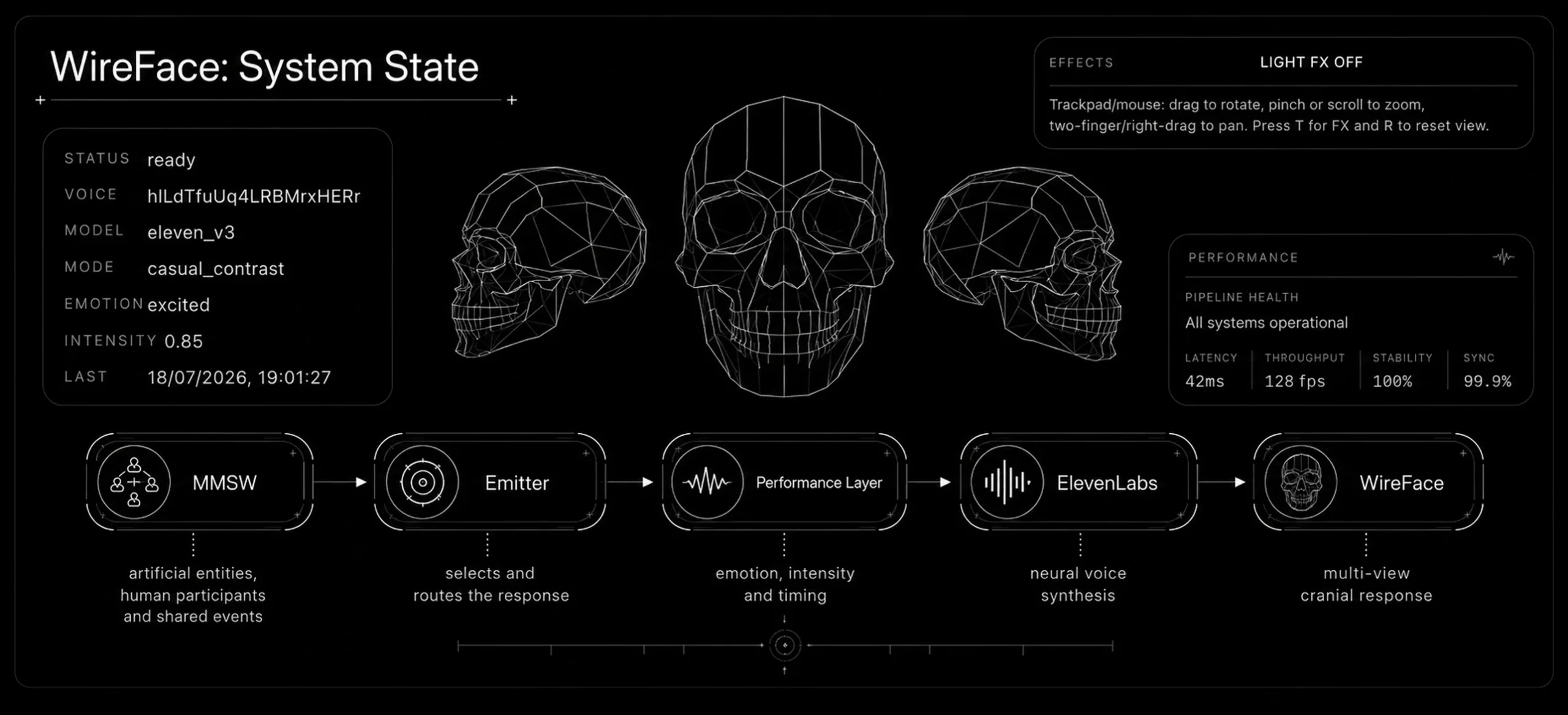
MMSW (Multicasting Multimodal Story Worlds) is the real-time orchestration environment connected to WireFace.
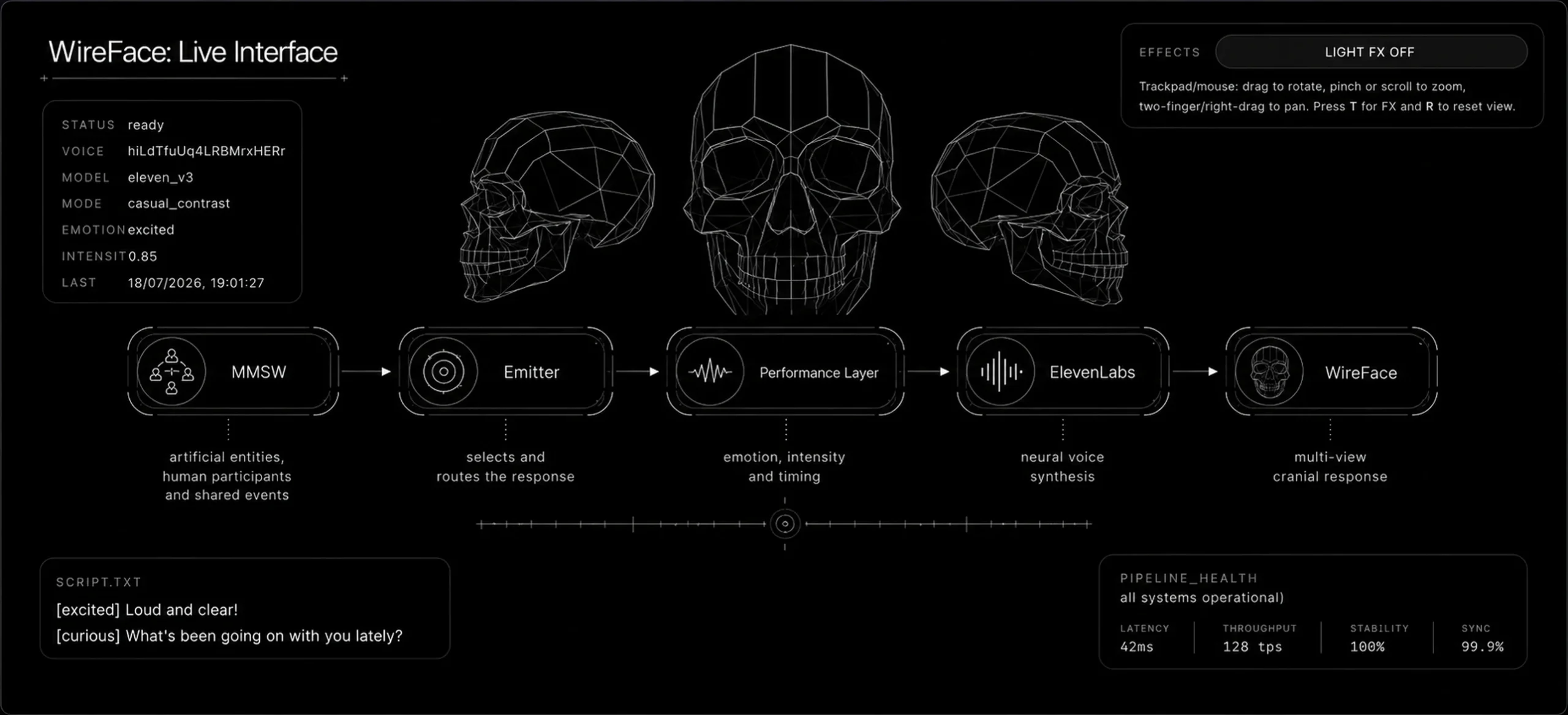
MMSW coordinates artificial entities, human participants and external interfaces within a shared multimodal environment. It organizes identity, context, memory, conversational turns, events and output destinations. WireFace operates as an embodiment and observation layer: it receives an identified response, prepares its performance and presents the result through synchronized views.
UID, session and message identifiers preserve the event’s origin throughout the flow. This separation between orchestration, emission, synthesis and visualization makes it possible to locate failures, compare components and connect new forms of presence without changing the entire system.
Operational Flow
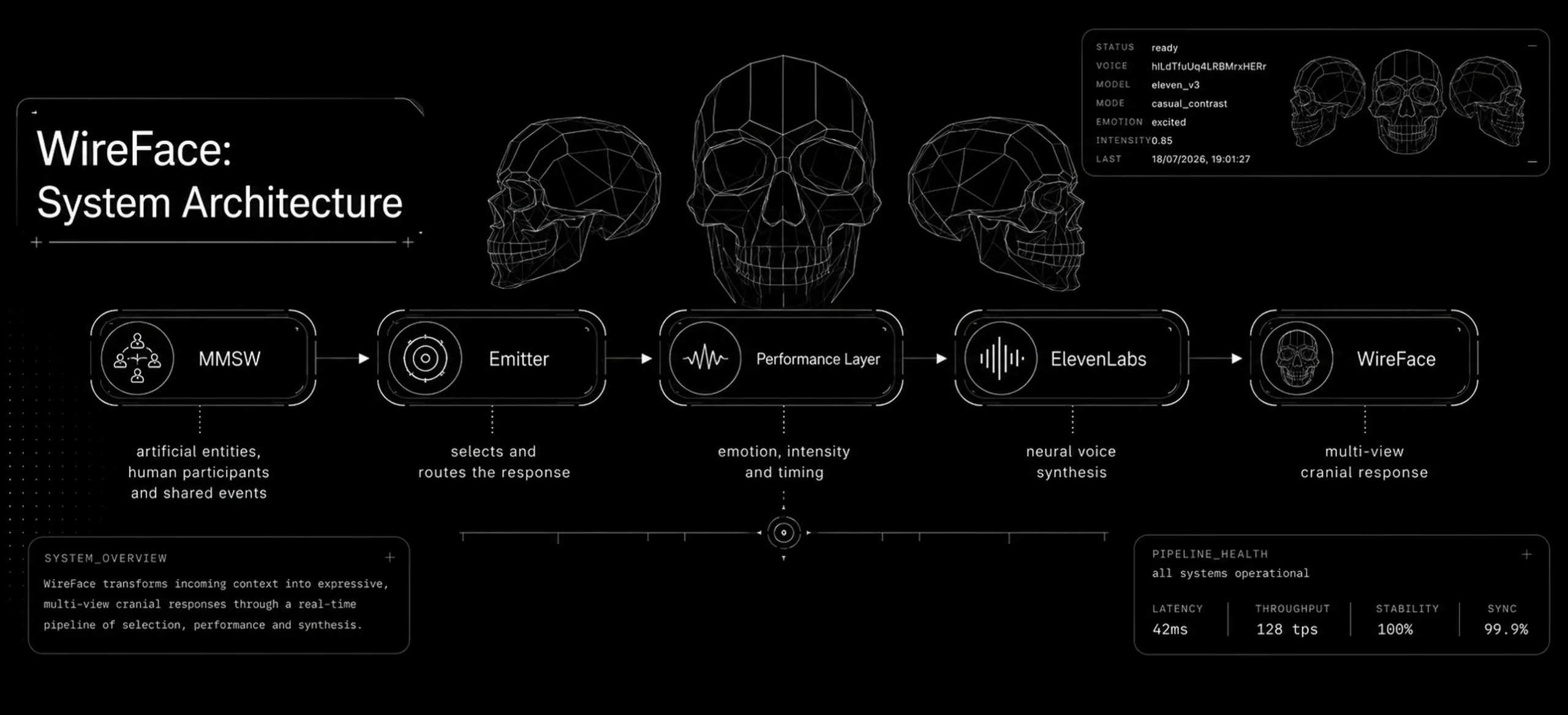
MMSW receives or produces an event associated with an entity and preserves its identifiers. The emitter selects the configured destination and delivers the content to WireFace. The performance layer transforms the available parameters into rhythm, intensity and timing; synthesis generates the voice; and the interface distributes the same state to the visual views. Telemetry records the outcome of each stage.
Modularity allows components to be measured, replaced or compared. It also separates the semantic response from its audiovisual execution, supporting controlled tests and integration with other forms of embodiment.
Multi-View Model
The three heads operate as diagnostic channels for the same performance. They share identity, state, audio and a temporal reference, while each camera exposes different aspects of rotation, jaw response, intensity and synchronization.
The model makes it possible to inspect whether a manifestation remains coherent when observed from several angles or presented through different media. Multiple views extend inspection; they do not multiply the entity or its decision.
Evaluation Criteria
WireFace instruments the path between an entity response and its embodied manifestation. The items below define what can be observed and compared; scientific results require real datasets, an experimental protocol and subsequent analysis.
- Identity traceability: preserves UID, session and message identifiers from origin to presentation.
- Routing and delivery: records emitter, receiver, destination, attempt and outcome.
- Stage latency: measures routing, receipt, interpretation, synthesis, preparation and rendering.
- Speech generation: records voice, model, text length, audio duration and synthesis time.
- Synchronization: measures drift between audio, timing marks and visible movement.
- State continuity: checks whether identity and parameters persist between messages and views.
- Reliability: identifies loss, duplication, expiration, retries and component-level failures.
- Portability: compares the same identity across web, holographic, XR, robotic and installation interfaces.
Instrumentation and Observability
Each response is treated as a measurable event. The dashboard accepts a JSON file exported by WireFace and organizes indicators for latency, synchronization, delivery, performance states and voice synthesis. Complete operational records remain separate from the public visualization.
Important — simulated data. The values currently displayed in the charts are synthetic data generated through controlled simulation exclusively to test the interface, filters and visualizations. They do not represent real WireFace measurements and must not be interpreted as research results, scientific validation or evidence of system performance.
Latency by stage
Average routing, interpretation, synthesis, preparation and rendering time.
End-to-end latency
Total response time across the selected events.
Synchronization drift
Difference between audio timing and visible movement.
Delivery status
Successful, retried, timed-out and failed events.
Emotion and intensity
Distribution of interpreted performance states.
Text length and synthesis time
Relationship between character count and ElevenLabs generation time.
Raw events
Visible only with ?wfdebug=1| Time | Session | UID | Message | Status | Total ms | Route | Performance | TTS | Render | Drift | Emotion | Intensity | Error |
|---|
Voice, Movement and Temporal Coherence
Voice forms part of embodiment. Pace, emphasis, pauses, rhythm and intensity influence how a response is perceived. ElevenLabs is used as a synthesis component, while WireFace records the generation and execution times associated with the event.
Cranial movement, orientation and jaw response visualize performance parameters. Comparing audio, timing marks and rendering makes drift detectable. The interface does not assume that movement proves intention or understanding; it records the technical correspondence between the available channels.
Potential Applications and Limitations
A continuous identity can be presented through a browser, hologram, projection, digital human, robotic entity, physical installation or volumetric interface. This portability may support research in telepresence, human-robot interaction, cultural mediation, education, performance art and responsive narrative environments.
The main advantage of the modular architecture is the separation of identity, orchestration, synthesis and presentation form. This allows interfaces to be compared, telemetry to be reused and a visual or physical body to be changed without redefining the entire entity.
Current limitations. Visual presence and synchronization do not demonstrate understanding, autonomy or operational safety. Real-world use requires appropriate sensors, action rules, fault handling, participant evaluation and validation specific to each body and context.
From AI Chronicles to WireFace
AI Chronicles investigates artificial entities, personification and narrative in multimodal environments. WireFace turns part of that inquiry into a technical embodiment infrastructure by instrumenting the relationship between identity, voice, movement, time and presence.
At the intersection of science and art, the platform allows a narrative hypothesis to become an observable experiment. Aesthetic expression proposes situations and forms of presence; instrumentation records how those manifestations are produced, synchronized and distributed.
Research and Development
Prof. Luiz Velho
VISGRAF Laboratory — IMPA
Matteo Moriconi
VFXRio
WireFace forms part of the collaboration between VISGRAF/IMPA and VFXRio on multimodal systems, artificial entities, embodiment, observability and new forms of digital and physical presence.
Scope note: the telemetry dashboard explicitly identifies simulated data. These data are used to test the interface and must not be presented as experimental results.